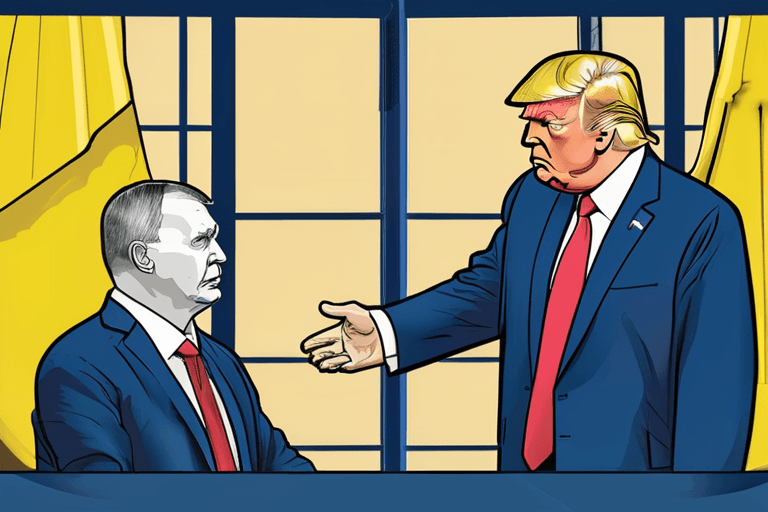
President Donald Trump stated Sunday that Ukraine and Russia are closer than ever to a peace agreement, following discussions with Ukrainian President Volodymyr Zelenskyy at Trump's Florida resort and a phone call with Russian President Vladimir Putin. Trump acknowledged that negotiations could falter, potentially prolonging the conflict, which began four years ago with Russia's invasion of Ukraine.
Trump described his conversation with Putin as "excellent," lasting two and a half hours. He asserted his belief that Putin desires peace, despite recent Russian attacks on Ukraine coinciding with Zelenskyy's trip to the United States for negotiations. "Russia wants to see Ukraine succeed," Trump said at a news conference after meeting with Zelenskyy, whom he repeatedly commended for his bravery.
Both Trump and Zelenskyy recognized that significant challenges remain, particularly concerning Russia's control over Ukrainian territory. Following their meeting, they contacted several European leaders, including Ursula von der Leyen, president of the European Commission.
The use of AI in analyzing geopolitical situations and predicting potential outcomes is becoming increasingly prevalent. AI algorithms can process vast amounts of data, including news reports, social media feeds, and economic indicators, to identify patterns and trends that might be missed by human analysts. This technology could potentially assist in identifying optimal negotiation strategies and predicting the likelihood of success for peace talks. However, the reliance on AI in such sensitive contexts raises ethical considerations. Algorithmic bias, stemming from biased training data, could skew analyses and lead to flawed conclusions, potentially exacerbating existing tensions.
The ongoing conflict between Russia and Ukraine has significant implications for global security and international relations. The potential for a peaceful resolution, facilitated by diplomatic efforts and possibly aided by AI-driven analysis, could de-escalate tensions and foster greater stability in the region. Conversely, a failure to reach a settlement could result in a protracted conflict, with far-reaching consequences for the global economy and geopolitical landscape.
The current status of negotiations remains uncertain. While Trump expressed optimism, the complexities of the territorial disputes and the divergent interests of the parties involved pose significant obstacles. Future developments will likely depend on the willingness of both sides to compromise and the effectiveness of ongoing diplomatic efforts, potentially informed by advanced AI analysis of the evolving situation.






















Discussion
Join the conversation
Be the first to comment